Introduction: Why Daniel 7 Matters for Readers Today
Daniel 7 stands as a cornerstone of biblical apocalyptic literature. Written in a period when empires rose and fell with dizzying speed, this chapter presents a night vision in which four potent empires ascend and recede, only to be eclipsed by an eternal, divine kingdom. For students of the Bible, the chapter offers a vivid study in symbolism, prophecy, and the sovereignty of God. It also invites careful exploration of how symbolism functions across genres—poetry, prophecy, and history—so that readers can discern both historical reference and enduring spiritual truth.
Although Daniel 7 is part of the broader Daniel text that includes prophetic imagery and court narratives, this particular chapter is written in the Aramaic section of Daniel (the same Aramaic language that covers Daniel 2 and Daniel 7). It is closely related to the material in Daniel 2, where a dream of a statue represents a succession of kingdoms. Together, these chapters offer complementary pictures: one statue-based, one beast-based, both underscoring God’s ultimate control over human kingdoms.
Overview of the Vision: What Daniel Sees and What It Means
In short, Daniel 7 describes a man’s night vision in which four wild beasts rise from a turbulent sea, each emblematic of a world empire or political power. A climactic figure—the Ancient of Days—sits in judgement, and a figure described as “one like a son of man” is given authority, glory, and an everlasting kingdom. The central message is clear: despite the volatility and sometimes brutal nature of earthly power, God’s reign is supreme and eternal.
Four beasts symbolize the succession of empires that dominate world history from Daniel’s era onward.
The ten horns on the fourth beast point to a later phase of imperial power with additional rulers.
The emergence of a little horn signals a pivotal antagonist who persecutes the saints and blasphemes against God.
The appearance of the Ancient of Days and the one like a son of man marks a turning point: divine judgement followed by an eternal kingdom given to the righteous, i.e., the saints and the Messiah figure.
In this article, we will explain the major symbols in Daniel 7, discuss how scholars interpret them, and outline how the chapter has been read across different theological traditions. We will also consider practical lessons for readers who seek to understand prophecy, sovereignty, and hope in times of political turbulence.
The Four Beasts: Symbols, Meanings, and Interpretations
The First Beast: A Lion with Wings
The vision begins with a beast resembling a lion, which has wings of an eagle. The image is striking: wings are plucked, the beast is lifted from the ground, and it is made to stand like a human being with a human heart given to it.
Symbolic meaning: Traditional interpretations identify this beast with Babylon, the great empire known for its swift military campaigns and the pomp of its court. The lion is a natural symbol of royal power, and wings add the dimension of speed and mobility. The plucking of wings and the transformation into a man signal a shift in power, perhaps a moment of humiliation or subordination within the Babylonian regime, or the way power is measured against divine sovereignty.
Thematic takeaway: The first beast introduces the larger pattern of human pride, strength, and eventual accountability before God. It also foreshadows that earthly triumphs are subject to change and that divine plan endures beyond the fortunes of empires.
The Second Beast: A Bear Staggers Up on One Side with Ribs in its Mouth
The second beast is described as a bear, raised up on one side and with three ribs in its mouth between its teeth. It’s told to “arise, devour much flesh.”
Symbolic meaning: This beast is widely understood to symbolize Medo-Persia, with the asymmetry (one side higher) representing the Persian empire’s eventual dominance over the other—Persia’s power ultimately outstripping Media. The three ribs likely denote the three great powers or exerts influence that Persia absorbs and then consumes as it expands.
Thematic takeaway: This image emphasizes the dynamics of alliance, conquest, and the way great empires grow by swallowing neighboring regions. It also underscores that even successful empires are not final—they are part of a larger, divinely ordered sequence.
The Third Beast: A Leopard with Four Wings and Four Heads
The third beast is a leopard with four wings on its back and with four heads. It’s one of the most striking composite symbols in the vision.
Symbolic meaning: This beast represents the Greek empire, established by Alexander the Great and characterized by rapid military campaigns. The four wings indicate extraordinary swift conquests, while the four heads point to Alexander’s empire being divided into four regions after his death (the four Hellenistic successor kingdoms: Ptolemaic Egypt, Seleucid Syria, and two others, often associated with Macedonian territories or eventually the kingdoms of the diadochi).
Thematic takeaway: The leopard’s speed and division reflect both martial success and the fragility of centralized power. It also shows how even a seemingly coordinated empire can fragment into competing jurisdictions, underscoring that human plans are subject to divine ordering.
The Fourth Beast: A Dreadful, Terrible, Iron-Teeth Monster with Ten Horns
The final beast is terrible, dreadful, and has iron teeth and ten horns. Its look conveys raw force and a ruthless appetite for power.
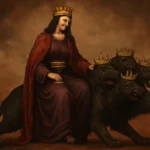
Symbolic meaning: This beast is commonly understood to symbolize the Roman Empire, renowned for its military might and legal-political structure. The ten horns signify a governance that fragments into ten rulers or ten regimes—an image of fragmentation, endurance, and eventual upheaval within a powerful system.
The little horn arises among these ten horns, different from the others in that it has eyes and a mouth that speak blasphemous words and arrogance. This figure is the central antagonist of the latter portion of the vision.
Thematic takeaway: The fourth beast embodies the long arc of oppressive power, yet even within that stronghold of force, God’s redemptive plan continues to unfold. The presence of the little horn signals a climactic challenge to faith and worship, inviting readers to consider the cost of fidelity under persecution.
The Ten Horns, the Little Horn, and the Clash with the Saints
The Ten Horns: A Stage of Ten Kings or Powers
The text notes that the fourth beast had ten horns, indicating a later period of political complexity. The number ten is symbolic as well as literal in apocalyptic literature, often signaling a comprehensive, complete set of rulers within a system.
Interpretive note: Some readers identify the ten horns with ten successive kings within the beast’s domain, while others see them as a symbolic representation of a broader era of power that culminates in the emergence of a more concentrated antagonist. The historical or futurist application varies depending on the interpretive tradition.
The Little Horn: A Figure of Persecution and Blasphemy
Among the ten horns, a single little horn arises, growing in influence and speaking pompous, blasphemous words. It is described as making war on the saints and prevailing for a time.
Symbolic meaning: The little horn represents a period or person of intensified opposition to God’s people. In historical readings, it has been associated with rulers such as Antiochus IV Epiphanes, who afflict the Jews during the Hellenistic period. In futurist or political-eschatological readings, it is linked with an ultimate antagonist that appears in the end times.
Themes: The little horn’s activity highlights the tension between divine worship and political power, the human capacity for blasphemous self-exaltation, and the idea that oppressive powers are allowed by God to test the faith of the saints before a decisive judgement.
The Ancient of Days and the Son of Man: The Divine Judgement and the Kingdom Forever
The Ancient of Days: Divine Judgement and Authority
The scene shifts to the Ancient of Days, a figure whose presence invokes timeless sovereignty. He sits on a fiery throne, and judgement is executed with a description of fiery flames and a judgement that weighs the deeds of the powers described earlier.
Symbolic meaning: The Ancient of Days is a portrait of God as the ultimate authority over history. The imagery of judgement—fiery tribunals, books opened, and the righteous vindicated—emphasizes that human empires are under divine surveillance and accountability.
The One Like a Son of Man: A Messianic Figure Receiving an Everlasting Kingdom
Amid the judgement scene, a figure described as one like a son of man appears and is given dominion, glory, and a kingdom that will never be destroyed. This figure stands before the Ancient of Days, and the kingdom is set to endure forever.
Symbolic meaning: The phrase “son of man” here is a human figure endowed with extraordinary authority. In later Jewish and Christian interpretation, the phrase becomes a title associated with the Messiah. The handing of an eternal, unshakable kingdom to this figure points to a divine plan in which God’s rule is not merely symbolic but concrete and enduring.
New Testament resonance: In Christian tradition, Jesus often uses the title “the Son of Man,” connecting his mission to the Danielic vision. This link invites readers to reflect on the relationship between Jesus’ ministry, his crucifixion and resurrection, and the anticipated consummation of God’s kingdom.
Prophetic Significance: How to Read Daniel 7 Across Time
Connections to Daniel 2 and the Larger Theme of God’s Sovereignty
Daniel 7 aligns with Daniel 2 in presenting a sequence of earthly powers that rise, dominate, and eventually recede in the face of God’s kingly rule. While the statue in Daniel 2 emphasizes the dream’s more static depiction of successive empires, the beasts of Daniel 7 convey a more dynamic and violent imagery that captures political change, revolution, and upheaval.
Common thread: In both visions, human kingdoms are real—and consequential—but they are not the final word. God’s sovereignty stands behind history, and a divine kingdom is the ultimate horizon for humanity.
Timeframes: The “Times of the Gentiles” and Beyond
A recurring theme in Daniel is the idea of time appointed by God. In Daniel 7, the period during which oppressive powers act against God’s people is described with phrases that have been interpreted as “time, times, and half a time” in other parts of Daniel and Revelation. While Daniel 7 itself does not use that exact phrase, interpreters often connect these ideas to the broader eschatological timeline.
Key insight: The goal of the chronology is not precise calendar archaeology but a theological assertion: history moves toward a divinely ordained end where the saints are vindicated, the adversaries are judged, and God’s eternal kingdom prevails.
Interpretive Approaches: How Different Traditions Explain Daniel 7
Preterist Readings: Historical Fulfillment in Ancient and Classical Times
In a preterist approach, Daniel 7 is read as largely fulfilled in the period from Daniel’s exile through the early centuries of the Common Era. The fourth beast (Rome) and the little horn (often associated with Antiochus IV Epiphanes or other later persecutors) are read as historical actors whose actions foreshadow future patterns but whose primary fulfilment is in the past.
Conviction: The emphasis is on how the vision offered hope to persecuted Jews in antiquity by showing that God judges oppressive powers and will vindicate the faithful, even when present circumstances are harsh.
Historico-Critical and Historicist Readings: Empire to Empire to End of Time
A historicist or historical approach sees Daniel 7 as a sweep through history from the setting of Daniel’s era to the end times. The beasts become symbols for a sequence of empires and, for some interpreters, for stages of the Christian church’s development as well.
Conviction: The text invites readers to see history as a theater where God remains central, and readers are called to discern how each era relates to divine purposes. Some historicist readings identify the little horn with later powers in church history or state power, though this is debated and depends on interpretive frameworks.
Futurist and Idealist Readings: End-Times Focus and Universal Principles
In futurist readings, Daniel 7 projects the most intense events into the last days. The little horn is connected with an ultimate Antichrist figure who arises toward the end of history, while the eternal kingdom is realized in the not-too-distant future.
In idealist or symbolic readings, the chapter’s imagery is read as timeless, spiritual archetypes: the struggle between human kingdoms and divine sovereignty, the persistence of evil, and the steadfastness of God’s people across ages.
Takeaway across schools: Regardless of the exact historical mapping, the central claim remains consistent: earthly powers are under God’s jurisdiction, and ultimate vindication belongs to the faithful who trust in God’s eternal rule.
Messianic Expectation and the Kingdom that Never Ends
How Daniel 7 Shapes the Messianic Vision
The presence of the one like a son of man receiving an eternal kingdom is a pivotal messianic motif. In Jewish expectation, the Messiah is often framed as a king who brings deliverance and restoration. Daniel 7 extends this expectation by presenting the Messiah figure as part of a cosmic judgement scene in which the heavenly court affirms a kingdom that cannot be demolished.
New Testament resonance: The Gospel accounts document Jesus’ use of the title Son of Man, thereby aligning his mission with the Danielic portrait of a divine-empowered human ruler who inaugurates God’s eternal dominion.
Kingdom Ethos: Justice, Righteousness, and Endurance
The themes surrounding the Ancient of Days, the judgement, and the Son of Man eventually translate into a vision of a kingdom characterized by righteousness, justice, and peace. The faithful—often described as the saints—are vindicated and participate in the rule of God in a transformed order.
Practical implication: For readers, Daniel 7 offers hope that present suffering and oppression are not the final chapters. The divine plan guarantees a future in which the eternal kingdom prevails and cosmic justice is realized.
Practical Implications: Living with Hope, Courage, and Discernment
What Daniel 7 Teaches About Suffering and Faithfulness
God is sovereign over history, even when human powers seem invincible.
Persecution of the righteous is not the final word; divine justice will be rendered.
Hope is grounded in the promise of an everlasting kingdom that cannot be shaken.
Prophetic symbols are multi-layered and open to various legitimate interpretations.
Different traditions may emphasize different aspects of the same text, but all can agree on the central message of divine sovereignty.
When engaging with prophecy, it is essential to balance historical context, literary genre, and theological aims.
Doctrinal Recommendations for Study
Study Daniel 7 alongside Daniel 2 to appreciate how different symbolic systems communicate a shared message about God’s control over history.
Pay attention to the language of judgement and kingdom, noting how the text moves from a crisis of power to a celebration of God’s eternal reign.
Be mindful of interpretive diversity, recognizing that honest scholars may differ on the precise identification of empires or the chronology of events.
Below are concise explanations to common questions about Daniel 7:
What does the four beasts imagery symbolize?
The beasts symbolize successive world powers that dominate human history. Each beast contains imagery (speed, power, division) that points to the particular empire it represents and its trajectory within God’s sovereign plan.
Who is the “one like a son of man”?
The figure is a human-like, divinely empowered ruler who receives an eternal kingdom. In Jewish and Christian readings, this figure is associated with the Messiah and is later linked to Jesus in the New Testament.
What is the significance of the Ancient of Days?
The Ancient of Days represents God’s ancient and eternal authority. The scene of judgement demonstrates that God will judge the powers of this world and establish a sovereign rule that endures forever.
How should modern readers apply Daniel 7?
Daniel 7 invites readers to trust in God’s sovereignty, maintain faith under pressure, and keep hope in the ultimate, incorruptible kingdom. It also encourages discernment about how symbols translate into real-world political and spiritual dynamics.
Daniel 7 is a rich, multilayered text that invites readers to read with both historical awareness and theological imagination. Its vivid imagery—four dramatic beasts, a ten-horned fourth power, a little horn that opposes the saints, and the climactic appearance of the Ancient of Days with the Son of Man receiving an endless kingdom—provides a framework for understanding the tension between human power and divine sovereignty. Across interpretive traditions, the core message remains strikingly consistent: earthly empires rise and fall, but God’s dominion is eternal; the faithful who endure in trust are invited to participate in an everlasting, just, and glorious reign.
Whether one engages Daniel 7 as a window into ancient history, a guide to future hope, or a symbol-rich meditation on the spiritual struggle between good and evil, the chapter offers a compelling reminder: history is under divine governance, and the ultimate horizon is the kingdom of God that never ends.