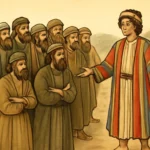
Joseph’s coat is one of the most recognizable images in the biblical narrative. Historically rooted in the Book of Genesis, this garment—often described as a «coat of many colors» in popular retellings—serves as a powerful symbol that opens up conversations about family dynamics, divine blessing, and the mysterious workings of fate. In many traditions, the tale centers on Jacob’s favoritism, jealousy among Joseph’s brothers, and the way a single article of clothing becomes a tangible sign of status, identity, and impending change. This article explores the meaning, symbolism, and the broader biblical story surrounding Joseph’s coat, weaving together literary analysis, historical context, and enduring interpretations across cultures.
The narrative of Joseph’s coat begins in Genesis 37, within the broader epic of the patriarchs. Joseph, the eleventh son of Jacob (also named Israel), is described as a young man of remarkable dreams and a favored son. His father’s special treatment is signaled by the gift of a distinctive garment, which is commonly rendered in English translations as a “coat of many colors” or a richly ornamented robe. The exact Hebrew phrase is ketonet passim, a term that scholars debate in translation, with implications about length, sleeves, or decorative qualities.
The giving of the coat is not merely about fashion. It functions as a visible marker of Jacob’s preference and, in the context of an extended family and land-based culture, signals a kind of inheritance and responsibility that Joseph has not earned through work or age. This clothing choice becomes a focal point for the unfolding tension: Joseph’s brothers see the garment as a daily reminder of their father’s partiality, and they respond with growing resentment.
The story quickly accelerates as Joseph shares two dreams in which he stands in a position of leadership over his brothers and even over his father and mother. The combination of the coat’s emblem of privilege and Joseph’s unfiltered confidence intensifies the conflict. Jealousy leads to a decisive act: the brothers plot to remove Joseph from the family life and ultimately sell him into slavery in Egypt. They deceive their father by dipping Joseph’s coat in the blood of a animal, presenting the garment as evidence that Joseph has died. Jacob’s grief over the loss of his favored son is profound, and the coat, now stained and altered, becomes a bitter symbol of what has happened.
In Egypt, Joseph’s life takes a dramatic turn from betrayal to a trajectory of influence, interpretation, and salvation, culminating in a dramatic reversal: the very garment that signified his father’s favor becomes a memory of suffering, while Joseph’s abilities—gifts for dream interpretation and administrative skill—lead him to the palace. The coat, though no longer in Joseph’s possession, remains a potent emblem of identity, loyalty, and providence—an emblem that invites readers to search for deeper meaning beneath outward appearances.
The Clothing as a Symbol: Meaning Behind the Coat
In ancient Near Eastern cultures, garments were more than practical apparel. They were markers of status, lineage, age, and role within a family or community. A special robe could indicate who belonged to the house of the father, who possessed authority, or who bore responsibilities for leadership. In the Joseph story, the robe functions as a social signal with implications that far exceed fabric and color.
Historical context for clothes and status
Clothing in biblical times often conveyed information about a person’s birthright, social place, and future possibilities. A long-sleeved robe or ornate mantle might mark a prince among the household, a trusted steward, or a favored son who carries responsibilities that others do not. In the Joseph narrative, the coat’s design would have set Joseph apart in a crowd of brothers, making him both conspicuous and vulnerable to envy.
Colors, meanings, and motifs
The phrase coat of many colors evokes an image of richness and beauty, but the symbolism can be more nuanced than a mere display of wealth. Colors in ancient symbolism often carried associations—red for blood or vitality, blue for heaven or divine favor, green for growth or renewal, white for purity, purple for royalty. While the Bible does not specify all the colors in Joseph’s garment, the idea of a multicolored or richly decorated robe conveys a sense of extraordinary status within the family. Modern readers may imagine a “Technicolor” robe, yet the ancient significance remains rooted in identity, destiny, and the fragile balance between love and envy that a family must navigate.
In many biblical texts, clothing becomes a metaphor for vocation or calling. The coat that Joseph receives can be interpreted as a sign that he has a particular path to walk—one that includes leadership, interpretation, and, ultimately, a role in preserving the family and the broader region through famine. The garment’s visibility makes Joseph a constant focal point in the family dynamics, aligning with themes of destiny and divine activity in the narrative.
Symbolic contrasts: favored status vs. communal harmony
The coat also highlights a tension between private affection and public fairness. Jacob’s preference for Joseph creates a rift that complicates the family’s moral ecosystem. The narrative invites readers to consider questions about parental favoritism, sibling rivalry, and the consequences of unequal treatment within a household. The garment thus becomes a symbolic lens through which to examine how a child’s perception of love and fairness can influence entire generations.
The Biblical Narrative: Key Episodes and Their Significance
Favoritism and tension within the family
The story’s opening emphasis on Jacob’s favoritism toward Joseph sets up a dramatic contrast with his other sons. This favoritism is embodied, in the text, by the gift of the special robe, which is a public sign of approval. The brothers’ awareness of this special status fuels their resentment, jealousy, and eventual decision to act. The narrative does not state that the coat alone provoked violence, but it is an irrefutable symbol of the unequal affection that destabilizes the family’s harmony.
Dreams as foreshadowing and motive
Joseph’s dreams—one in which he and his brothers are binding sheaves, and another in which the sun, moon, and eleven stars bow before him—function as foreshadowing devices. The dreams underscore Joseph’s sense of a future leadership role for himself, which he discloses, perhaps naively, to his brothers and his father. The juxtaposition of a dream-foretold destiny with the present reality of familial strife intensifies the sense that the coat and Joseph’s person are central to a larger, divine narrative. Some readers interpret the dreams as a legitimate revelation of destiny, while others see them as youthful arrogance that fuels conflict.
The turning point: betrayal, loss, and the road to Egypt
The turning point is the brothers’ decision to remove Joseph from the family circle and sell him into slavery in Egypt. The coat—now stained with animal blood and presented to Jacob—becomes a weapon in the brothers’ deception, transforming a garment into a witness against a hoped-for outcome. Jacob’s mourning illustrates the depth of loss that favoritism can produce when it is misread or misused. The narrative’s center shifts from the coat as symbol of privilege to the coat as artifact in a chain of events that will reconnect the family later in the saga.
The arc of redemption: from betrayal to leadership
In Egypt, Joseph’s abilities—particularly his skill at interpreting dreams—elevate him from a captive to an advisor to Pharaoh. The coat’s memory becomes a through-line that traces the transformation from domestic strife to public leadership. The eventual reunion with his brothers and the restoration of family ties demonstrate a broader biblical theme: providence can work through human wrongdoing to accomplish a greater good. The robe’s legacy thus spans loss, precision of fate, and eventual reconciliation.
Symbolic Interpretations and Theological Themes
Providence and the sovereignty of God
A central interpretive thread in the Joseph narrative is the sense that God’s purposes unfold even when human agents act with flawed motives. The coat’s presence at key moments invites readers to consider how outward appearances and complex human actions interact with a hidden divine plan. The text often invites readers to see the story as a demonstration of divine providence at work—how a favored son’s identity, expressed through clothing, becomes part of a larger movement toward preservation and blessing.
The dynamic of jealousy around the garment compels ethical reflection: how should families navigate differences in affection, achievement, and responsibility? The coat becomes a moral mirror for the brothers as well as for Jacobs and readers today. The narrative does not condone manipulation or violence, but it does present jealousy as a powerful human force that needs honest reckoning within a community.
Identity, vocation, and the formation of leadership
Joseph’s trajectory—from the receiver of a distinctive garment to a leader who saves a nation—poses questions about how identity is formed. Is the coat a mere symbol, or does it actively shape Joseph’s self-understanding and the expectations placed upon him? The text invites readers to think about how clothes, status, and family narratives contribute to the making of a leader who must balance justice, mercy, and practical wisdom.
Memory, loss, and the ethics of remembrance
The marker of the coat in Jacob’s memory underscores the power of objects to crystallize experience, memory, and emotion. Even after the coat’s appearance has faded from daily life, it remains a potent symbol for a father’s grief and a family’s evolving history. The ethics of remembrance—how we honor or interpret the past—are not incidental; they shape present choices and future relationships.
Cross-Cultural Echoes and Comparative Perspectives
While the biblical story of Joseph and his coat is distinct to the Hebrew Bible, readers across traditions have drawn parallels and contrasts with related motifs in other religious narratives. In Christian interpretation, the tale is often read as a portrait of God’s providence, humility, and the necessity of forgiveness. In Jewish interpretation, the emphasis may be placed on the paternal dynamic, the ethics of family loyalty, and the survival of the clan through adversity. In Islamic tradition, Joseph (Yusuf) is celebrated as a prophet, and while the Qur’anic narrative emphasizes his chastity, patience, and trust in God, there are motifs of testing and ultimate vindication that resonate with the biblical arcs of trials and reconciliation. Some scholars note a different textual emphasis in the Qur’anic account, where the external signs of status are less about a physical robe and more about the moral integrity and steadfast faith Joseph maintains.
These cross-cultural reflections show how a single garment motif can stimulate broader conversations about identity, power, and faith. Whether one reads the tale through a lens of literary analysis, historical-cultural study, or faith-based devotion, the device of the coat provides a tangible entry point into larger themes that recur across communities and ages.
The Coat in Art, Literature, and Popular Culture
Over centuries, artists, composers, writers, and filmmakers have revisited the image of Joseph’s coat and the dramatic consequences it triggers. The garment has appeared in visual art as a symbol of familial tension and divine purpose. In literature and theatre, the coat serves as a powerful prop that marks a pivot from innocence to experience, and from private sorrow to public leadership. In film and television adaptations, the coat often becomes a memorable visual cue that orients the audience to the central conflict and the eventual reversal of fortune.
Visual arts: Paintings and murals depict the moment of revelation, the brothers’ conspiracy, or Jacob’s mourning, with the coat serving as a focal point of emotion.
Music and poetry: Ballads and hymns sometimes use the imagery of a robe or mantle to explore themes of favor, betrayal, and grace.
Modern retellings: Contemporary novels and screenplays reinterpret the coat to probe issues of family dynamics, identity formation, and resilience in the face of betrayal.
Regardless of medium, the garment remains a compact symbol that invites audiences to reflect on how external signs of status interact with inner virtues, family loyalties, and the slow, unfolding work of history.
What exactly did the coat signify? Was it a long-sleeved robe, a ceremonial mantle, or a robe of office? The ancient Hebrew term ketonet passim leaves room for interpretation, and readers debate whether the color or cut conveyed specific status.
Did Joseph’s own words about his dreams contribute to the conflict? Some scholars argue that his openness about the dreams revealed a noble calling, while others view it as youthful indiscretion that provoked jealousy.
Was the coat a real cause of the brothers’ hostility, or merely a convenient symbol? Many interpret the garment as a powerful symbol that magnified existing tensions rather than being the sole cause of betrayal.
How does the coat’s legacy function in the overall theology of Genesis? The narrative often prompts readers to weigh human choices against divine purposes and to consider how apparent misfortune can lead to collective good.
These questions are not just academic; they invite readers to consider how signs of privilege operate in real families today. The dynamic between favor and fairness, visibility and vulnerability, remains a living topic in homes, schools, and communities around the world.
Beyond its literary artistry and theological depth, the tale of Joseph’s coat offers practical, ethical guidance for contemporary life. Some core lessons include:
Beware of favoritism: Recognize how unequal affection can sow division within families or organizations, and strive for equity that honors each person’s needs and contributions.
Guard against envy: Jealousy can distort perception and prompt harmful actions. Cultivating empathy and constructive dialogue helps prevent escalations.
Honor discernment and accountability: Joseph’s abilities—interpretation, governance, and strategic thinking—are valuable when used for the common good. Leadership requires responsibility and ethical conduct.
Understand that appearances are not destiny: A single garment or a single moment does not define a person. Providence and human choices intersect in complex ways, producing outcomes that defy simple explanations.
Seek reconciliation: The latter part of the story emphasizes forgiveness and reunion. Restorative steps, even after significant harm, can heal communities and create a shared future.
In classrooms, sermons, and family discussions, the narrative of Joseph’s coat continues to prompt reflection on how we interpret signs of status, how we respond to those who stand out, and how we participate in a larger drama of resilience, mercy, and renewal.
For readers and writers, it can be helpful to track the different ways the garment is described. Common variants include:
Coat of many colors (the classic English rendering, popularized in songs and films)
robe or robe of many colors
Ketonet passim (the Hebrew term)
Garment or clothing as a less specific reference
Long-sleeved cloak or mantle depending on translation
Each phrasing carries nuance about length, decoration, and social meaning. For scholars, paying attention to these differences helps illuminate how translators, commentators, and editors shape readers’ perception of the text. For educators and students, acknowledging a range of translations can deepen understanding of how a single artifact—a garment—can mean many things at once.
The coat in Joseph’s story is more than a piece of fabric. It is a complex symbol that encapsulates a web of relationships—between son and father, between brothers, and between a family and a future nation. It also marks the intersection of human agency and divine purpose, reminding readers that outward signs of favor or status can catalyze growth as well as conflict. Across generations, the image of the robe continues to inspire discussion about fairness, destiny, leadership, and mercy.
Whether approached as a piece of literary symbolism, a cultural artifact, or a religious emblem, Joseph’s coat remains a vivid, multifaceted gateway into some of the Bible’s most enduring questions. By examining its meaning, its symbolism, and its place in the larger biblical story, readers gain a richer understanding of how clothing, family dynamics, and faith intersect in powerful, sometimes challenging, ways.