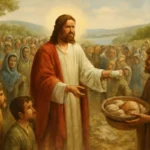
Below is an in-depth exploration of Jesus feeds the five thousand, a foundational miracle in the Gospels. Known for its mass audience, its dramatic display of provision, and its rich theological texture, this event invites readers to consider who Jesus is, how God works with human weakness, and what it means to trust divine abundance in ordinary life. This article uses the different gospel accounts to provide a thorough, balanced picture, while offering historical, literary, and devotional insights that can illuminate faith today.
Setting the Scene: Where and When Does the Miracle Happen?
The narrative of the feeding of the five thousand unfolds in the context of a large crowd that seeks out Jesus after a period of ministry among the villages around the Sea of Galilee. In the Gospel accounts, believers find themselves in a remote, deserted place or a wilderness setting—a place away from the bustle of towns, where people listen to Jesus and are hungry for teaching as well as healings. The timing is often described with terms like near or near Passover in John’s Gospel, situating the event within a pivotal liturgical calendar and signaling a deeper connection to biblical motifs around provision and God’s deliverance.
What makes this moment particularly striking is not only the size of the crowd—often described as five thousand men, with women and children included in the broader audience—but also the practical challenge that arises: insufficient food to feed everyone gathered. The miracle occurs in the simple, human context of need, which is part of what makes it so relatable and enduring for readers across generations.
The Texts Across the Gospels
Scholars note that all four canonical Gospels include an account of this miracle, though the emphasis and details vary. The synoptic Gospels—Matthew, Mark, and Luke—tend to present a similar sequence: Jesus teaches the crowd, the disciples report the shortage of food, a small supply is offered, Jesus blesses and distributes it, and a plentiful outcome follows. The Gospel of John adds distinctive theological layers, including hints about Jesus’ identity and signs that point toward his person and work.
Matthew’s account
In Matthew, the narrative unfolds with Jesus’ compassion for the crowd, a test of the disciples’ faith, and an explicit action of Jesus taking the loaves and fishes, offering thanks, and distributing them through the disciples. The scene culminates in a practical provision—basketfuls of leftovers—which signals abundance and the sufficiency of God’s provision for those who follow Jesus. The wording emphasizes not only the miracle itself but also the communal sharing that follows.
Mark’s account
In Mark, the feeding miracle is tied closely to the disciples’ commissioning and the crowd’s needs. The Gospel highlights the instruction Jesus gives to the disciples to organize the people into groups, and it underscores the act of blessing and breaking the bread as a sign of Jesus’ authority. Mark’s portrayal reinforces the idea that provision is distributed through the disciples, who participate in the miracle by carrying out Jesus’ commands.
Luke’s account
Luke emphasizes the pastoral and compassionate aspects of the event. The crowd is described as hungry and eager to learn, and Jesus responds with practical care as well as spiritual teaching. The miracle is framed as an instance where the Lord’s abundance meets human need, and the disciples’ practical question—“How can we feed all these people?”—invites a response that depends on divine generosity rather than human calculation.
The Gospel of John
In John, the feeding of the five thousand is reinterpreted in light of Christ’s identity and mission. John stresses that the miracle foreshadows the bread of life theology, inviting readers to see Jesus as more than a provider of physical food. The event becomes a sign that points to Jesus’s ongoing work of giving life and sustaining faith. John’s account connects this moment to a larger proclamation about who Jesus is, culminating in themes about abundance through intimate relationship with the divine.
Theological Significance: What does this feast reveal about Jesus?
The feeding of the five thousand is more than a single moment of provision; it unfolds as a multifaceted revelation about Jesus’ identity, his mission, and the nature of God’s care for creation. Several strands of meaning recur across the gospel accounts and invite careful reflection.
Compassion and proximity: Jesus sees a crowd in need and responds with care. The miracle begins not with grand rhetoric but with a listening, compassionate posture toward people who are hungry—physically and spiritually.
Authority and blessing: The act of taking the loaves, blessing them, breaking them, and giving them to the disciples to distribute models a sequence that echoes Jewish blessing practices and anticipates Jesus’ authoritative role in providing for humanity.
Provision through community: The disciples play a critical role in distributing food. The story suggests that God’s provision often arrives through human agents who cooperate with divine empowerment.
Abundance and left-overs: The miracle ends with more food than was needed—“twelve baskets full” in some versions. This abundance signals that God’s supply is generous and ample, even when human resources seem limited.
Signs pointing to a greater reality: In John’s gospel, the feeding is a sign that points beyond the miracle itself toward Jesus as the “Bread of Life,” inviting belief that Jesus sustains eternal life as well as physical life.
The Role of the Disciples: Faith, Fear, and Function
One of the most instructive aspects of the feeding of the five thousand is the involvement of Jesus’ closest followers. Their questions, doubts, and actions reflect a balance between human limitations and divine possibility.
Presenting the problem: The disciples are the ones who report “it would take more than half a year’s wages to buy enough bread for each person to have a bite.” Their assessment demonstrates practical realism and a concern for order, which makes the subsequent miracle more striking.
Offering a small gift: They present a boy’s small supply—five loaves and two fish—as the starting point for Jesus’ compassion. The fact that something so modest can become a conduit of abundant grace is a powerful reminder about the value of small offerings placed in God’s hands.
Receiving instructions: Jesus directs them to seat the people in groups and to distribute the food in an orderly way. The disciples’ obedience is essential to the miracle’s unfolding, highlighting the partnership between divine initiative and human response.
Learning through experience: After the miracle, the disciples gather leftovers, reinforcing a pattern: operating in faith often yields more generosity than expected, and obedience to Jesus’ direction leads to outcomes that exceed human anticipation.
A Crowd in the Wilderness: Audience, Need, and Response
The setting—an expansive field or wilderness area near the Sea of Galilee—gives the crowd a dual experience: a spiritual teacher who speaks with authority, and a provident savior who meets urgent bodily needs. The crowd’s response to the miracle ranges from astonishment to questions of political or Messianic expectation. In some accounts, the sign prompts people to attempt to force Jesus to become king by force, revealing a tension between popular expectation and the true nature of Jesus’ kingship, which is rooted in service, sacrifice, and love rather than conquest.
Several factors draw people to Jesus: healing, teaching, and the promise of relief from everyday burdens. The feeding episode underscores that Jesus meets both physical hunger and spiritual longing. The event also models the rhythm of ministry in which teaching leads to action, and action leads to deeper teaching—each reinforcing the other as part of the Gospel narrative.
Across the gospel accounts, several layers of symbolism accompany the miracle. Some themes have direct ethical or liturgical implications, while others operate on a more devotional or symbolic level.
Bread as a symbol: Bread is a basic staple and a sign of sustenance. In Christian theology, bread often becomes a sign of God’s ongoing care and the sustenance that comes through Christ, who is later described as the Bread of Life.
Multiplicity from unity: A small, common supply becomes enough for a large crowd, illustrating the idea that God’s grace can multiply when shared in faith and cooperation.
Communal sharing: The distribution process emphasizes community with shared resources, rather than hoarding, reflecting the values of generosity and mutual support that characterize the early Christian community in narrative memory.
Bread and blessing: The act of blessing the bread before distribution highlights the place of prayer and gratitude in experiencing divine provision, a pattern echoed in many biblical meals and rituals.
To appreciate the feeding of the five thousand, it helps to situate it within the broader religious and literary landscape of first-century Palestine. Miracle stories function in scripture not merely as demonstrations of power but as signs that reveal who God is and how God acts in history. They often engage with Jewish messianic expectations, agricultural life, and social needs of the crowds.
From a literary perspective, the narrative uses rhythm—descent into scarcity, blessing, distribution, and abundance—to convey a message about Jesus’ authority and the formation of a new community around him. The audience, the disciples, and the public witnesses all participate in a drama that moves from need to abundance, from human limitation to divine sufficiency.
Miracles in biblical literature commonly function as signs of prophetic vocation, divine approval, and the in-breaking of God’s kingdom into present reality. The feeding miracles often resemble the Old Testament stories of manna in the wilderness or provisions during times of famine, but they also point forward to the Christian Eucharistic tradition, where bread is remembered as a gift from God and a sign of fellowship with Christ.
Readers today can draw several practical applications from the feeding of the five thousand. While careful to respect the text’s historical and theological dimensions, these lessons speak into contemporary faith communities, personal spirituality, and ethical life.
Trust in God’s sufficiency: When resources seem limited, the narrative invites believers to trust that God can multiply what little they have when placed in Jesus’ hands.
Cooperation in mission: The disciples’ role reminds Christians that ministry involves teamwork. God often accomplishes big things through ordinary people who are willing to participate in God’s plan.
Care for the vulnerable: The crowd’s needs—physical hunger and spiritual hunger—call followers to be attentive to both body and soul, to provide nourishment in practical and spiritual forms.
God’s provision often comes with surplus: The leftovers imply abundance—God’s generosity toward those who receive and share, not merely meet optional desires but meet essential needs and create room for generosity toward others.
Christological reflection: For readers of John, the incident invites contemplation of Jesus as the true Bread of Life, whose gifts sustain eternal life beyond the immediate meal.
Below are some commonly raised questions about the feeding of the five thousand, along with concise clarifications that help sharpen understanding while avoiding over-simplification.
Was there really enough food to feed everyone? In the biblical narrative, Jesus’ blessing and distribution lead to an unmistakable outcome of abundant provision—enough for all, with leftovers. The emphasis is less on logistics and more on divine sufficiency and faith.
Why did Jesus test the disciples? The disciples’ questions reveal human concern and realism, but Jesus uses their concern to invite them into action, testing not their lack of faith but their willingness to participate in God’s plan.
Are the miracles meant to be interpreted symbolically or literally? Many scholars affirm a literal miracle with profound symbolic significance. The narrative often invites both readings: a historic event that also teaches theological truths about Jesus and God’s provision.
What is the connection to the Eucharist? In later Christian reflection, the feeding of the five thousand is seen as a precursor to the sacramental meal, where Jesus is acknowledged as the source of nourishment and life. John’s Gospel, in particular, lays groundwork for this sacramental understanding by connecting physical bread with the spiritual “Bread of Life.”
How should this story guide Christian action? The story calls Christians to imitate Jesus’ compassion, to serve the crowd, to share resources generously, and to trust in God’s ability to multiply what is given in love and service.
The narrative of Jesus feeds the five thousand stands as a powerful example of how one can bridge human need with divine generosity. Across the four Gospel accounts, the story affirms essential truths about who Jesus is—both as a teacher who speaks with authority and as one who acts with compassionate provision. It presents a pattern for Christian life: observe a need, offer what you have—even if it seems insufficient— entrust the moment to God, and participate in the distribution of grace to others. The leftovers become a symbol of God’s abundance, indicating that the divine economy is not constrained by human calculation and that generosity, shared within a community, creates space for others to be fed, cared for, and invited into deeper relationship with Christ.
As readers reflect on this miracle, they may consider personal questions: How does Jesus’ provision transform the way I view scarcity? In what ways can I participate in God’s work of feeding others—whether through practical acts of service, time, or resources? And how might the bread narrative shape my understanding of spiritual nourishment—what it means to be fed by Christ, the Bread of Life, and to become a conduit of that life to others?
The feeding of the five thousand is more than a historical episode; it is a living story that continues to shape how Christians think about trust, community, and divine generosity. By examining the varied gospel perspectives, one can appreciate the richness of how this miracle communicates both a moment in Jesus’ earthly ministry and a sustained invitation to the Christian life: to follow Jesus into places of need, to participate in his work, and to receive the grace that multiplies through faith and action.
In short, the miracle of the loaves and fishes—often titled the feeding of the five thousand—teaches that God provides, that Jesus is the Bread of Life, and that shared generosity creates a community where no one is left hungry in any real sense. Whether read as history, symbol, or a training ground for discipleship, this event remains a cornerstone of biblical narrative and a nourisher of faith for countless readers across generations.